Transforming silence into color, rhythm, and form through the art of Nadia Wamunyu

inableAdmin
When you meet Nadia Wamunyu, a contemporary visual artist born in 1993 and based in Nairobi, you encounter more than an artist. You meet a storyteller who, in her own words, paints “to be heard without sound.”
Her love for art began when she was just three years old. “My father recognized my artistic talent early on and bought me my first set of watercolors and brushes,” Nadia recalls. That same year, her life shifted after a doctor’s misdiagnosis, and the prescription of the wrong antibiotic led to hearing loss. At first, her family did not realize what was happening. A nursery school teacher even suggested she could not continue with her education. Later, tests revealed the truth: “My mind was intact. I was as bright and gifted as my twin sister, Sadia. I simply needed a hearing aid to navigate the world.”

Silence shaped Nadia’s early life in profound ways. “Sound was not always reliable,” she explains. “I lived with silences, gaps, and misunderstandings that made communication challenging. This often left me feeling like an outsider, watching rather than participating, listening with my eyes instead of my ears.” Over time, her eyes became her ears. She learned to read lips, observe gestures, and hold details in memory, which sharpened the sensitivity that now guides her art.
In this silence, Nadia discovered her true language. “At around eight years old, I began to realize that drawing could hold my memories, feelings, and experiences in ways that speech could not. What I couldn’t say out loud, I could show on paper.” Art became a bridge to connect with others, offering confidence, purpose, and visibility in spaces where silence might have left her unseen.
Painting remains deeply personal for her. “For me, creating art is both survival and celebration. It is survival because it allows me to express emotions that might otherwise remain locked inside. It is a celebration because it transforms those struggles into beauty, connection, and meaning. Painting is my way of insisting on presence, of saying I am here, I feel, I remember, I exist.”
Among her works, The Silence Between Us holds special significance. “I created it during a period when I was struggling with anxiety and the weight of partial hearing loss. The piece shows a figure emerging from layers of coffee stains and ink, her body both dissolving into and resisting the background. It was about trying to visualize what silence feels like. Not emptiness, but a space full of emotions, misunderstandings, and longing for connection.”
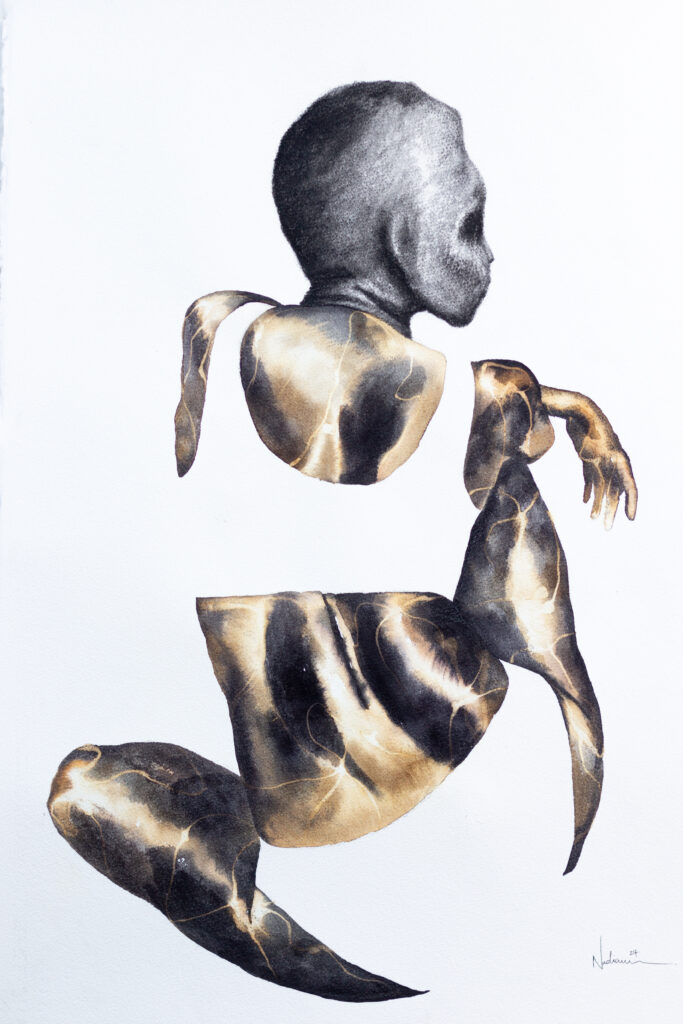
Much of Nadia’s art celebrates Black women. “I paint Black women as powerful, sensual, vulnerable, complex beings, fully human and unapologetically visible,” she says. “Each painting is a way of saying we exist in our fullness, we matter, we are worth celebrating.”
Her practice also challenges perceptions of disability. “Living with partial hearing loss, I understand how it feels to be misjudged or excluded because of an invisible difference. Rather than masking this experience, I channel it into my practice. I want people to see that disability is not absence, but presence, a presence that shapes creativity, resilience, and unique forms of expression.”
This vision was clear when Nadia took part in the Inclusive Africa Conference 2024, convened by inABLE. She exhibited her art and spoke in a session. Reflecting on its significance, she shares, “Platforms like the Inclusive Africa Conference are invaluable because they bring disability inclusion into global conversations that too often overlook the arts. For artists like me, the conference opens up space where creativity, accessibility, and innovation intersect.”
Looking ahead, Nadia imagines her art expanding into multi-sensory experiences that weave technology and accessibility together. “If I could design a project that brings together art, accessibility, and technology, it would be an interactive exhibition where people experience art beyond sight and sound. My paintings would be translated into tactile surfaces that can be touched, with projections that shift with movement. For audiences with hearing loss, vibration and rhythm could be built in so they can feel the art. Accessibility would not be an afterthought, but a creative engine.”
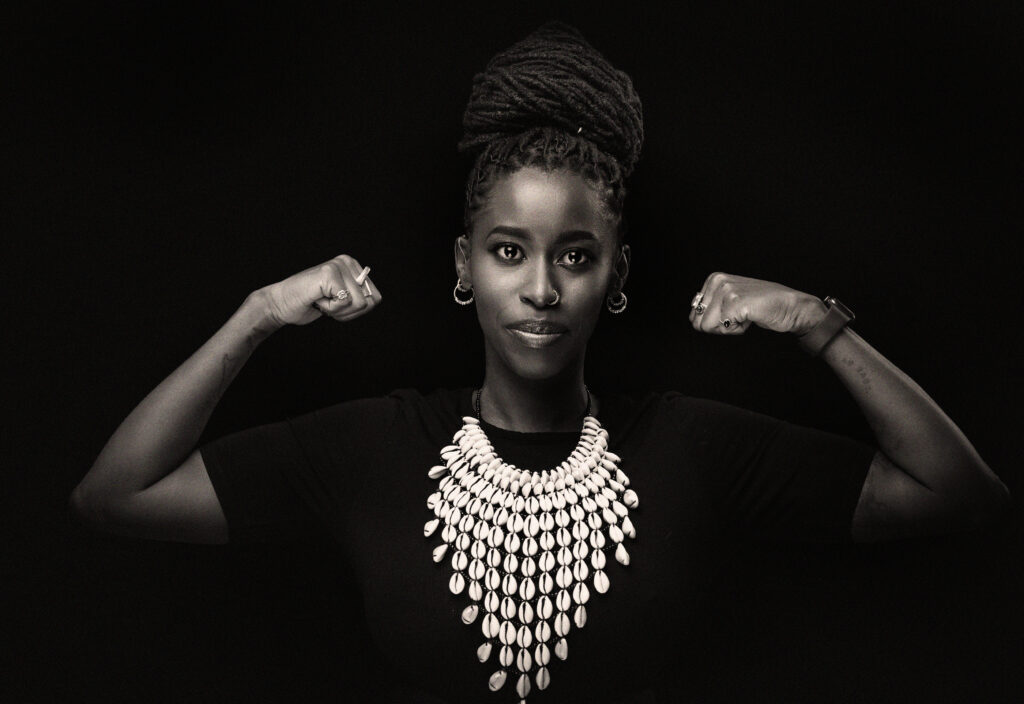
To young people with disabilities, Nadia’s message is filled with conviction. She says, “Anything is possible. Your difference does not define your limits. It can become your strength. Be patient with yourself, trust your creativity, and never compare your path to anyone else’s. The world needs the unique perspective only you can bring.”
Through her words and her paintings, Nadia shows that silence is not empty. It holds rhythm, color, and depth that she continues to share with the world.
Story by Faith Rimas-MPRSK, inABLE