Brian, A Young Innovator, Builds the Future with Code

inableAdmin
At Likoni Primary School for the Blind in Mombasa, 15-year-old Brian, a Grade 9 student with low vision, is discovering new possibilities through technology. During his free time, Brian immerses himself in coding projects on his Chromebook, using Scratch, a visual programming language designed to make programming more accessible to young learners.
One of his proudest creations is a simple web-based game where the player must keep a ball from hitting the ground. The design may look simple, but what Brian is achieving is remarkable. By using drag-and-drop code blocks, he has built a functioning game, learned the fundamentals of programming, and refined his critical thinking skills independently. More than just playing games, Brian is creating them.
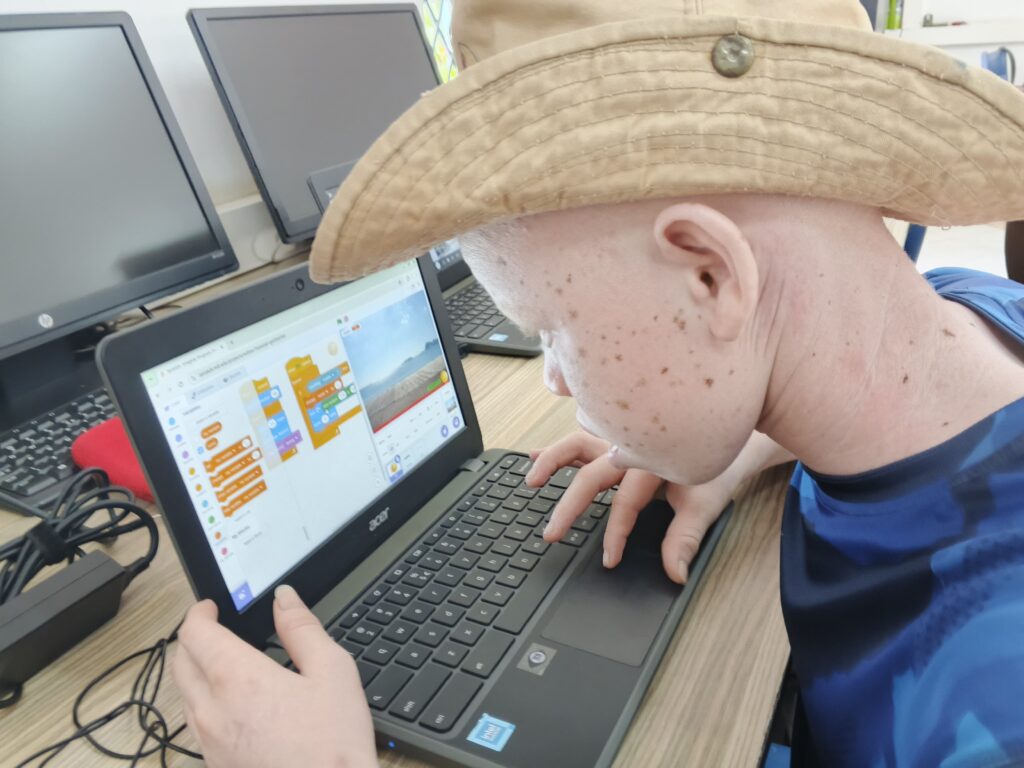
His journey is made possible through access to inABLE’s Assistive Technology Lab, where students who are blind or have low vision are introduced to digital skills and tools that expand their learning and self-expression. These labs are tailored to equip students with the knowledge and confidence to participate in the digital world independently.
As Brian prepares to move to Grade 10, he shares a concern that reflects the reality faced by many students with disabilities: “Will I be allowed to carry my Chromebook to continue learning? Will the inABLE computer program still be at my new school?” These questions reveal a broader need to ensure that learners with disabilities continue to have access to the tools and training they rely on as they advance in their education.
Brian’s story is part of a larger journey that began in 2009, when inABLE’s founder, Irene Mbari-Kirika, met a group of bright, blind students during a reading event at the Kenya National Library in Thika. She learned that these students were sharing a limited number of Braille books, which made it difficult to learn efficiently. The lack of accessible reading materials exposed a larger issue: visually impaired learners were being left behind. Irene knew more could be done to bridge this gap.
This moment of insight sparked the creation of inABLE’s first Assistive Technology Lab at Thika Primary School for the Blind. The initial lab offered access to online materials and basic computer skills training to 100 students. Since then, inABLE has expanded its reach to over 14,500 learners and now operates eight fully equipped labs in six schools for the blind across Kenya.
Each of these labs provides more than just infrastructure. Students receive comprehensive training in basic computer literacy, advanced digital skills such as HTML coding and web design, and hands-on experience using a variety of digital devices, including chromebooks. Peer-to-peer learning is also encouraged, with advanced students helping to mentor their classmates, creating a supportive environment where learners grow together.
By integrating digital skills into the classroom, inABLE enables students like Brian to learn independently, develop new interests, and explore future career paths. It is not just about technology; it is about access, dignity, and opportunity.
Still, Brian’s concerns serve as a timely reminder that the journey does not end in one classroom. Long-term impact requires continued investment, policy support, and collaboration to ensure learners with disabilities do not lose momentum as they transition between education levels.
You can be part of this journey. To support or partner with inABLE in expanding inclusive digital learning for students like Brian, visit https://inable.org/get-involved/ or email partnership@inable.org
Written by Eunice Kilungu and Faith Rimas, inABLE